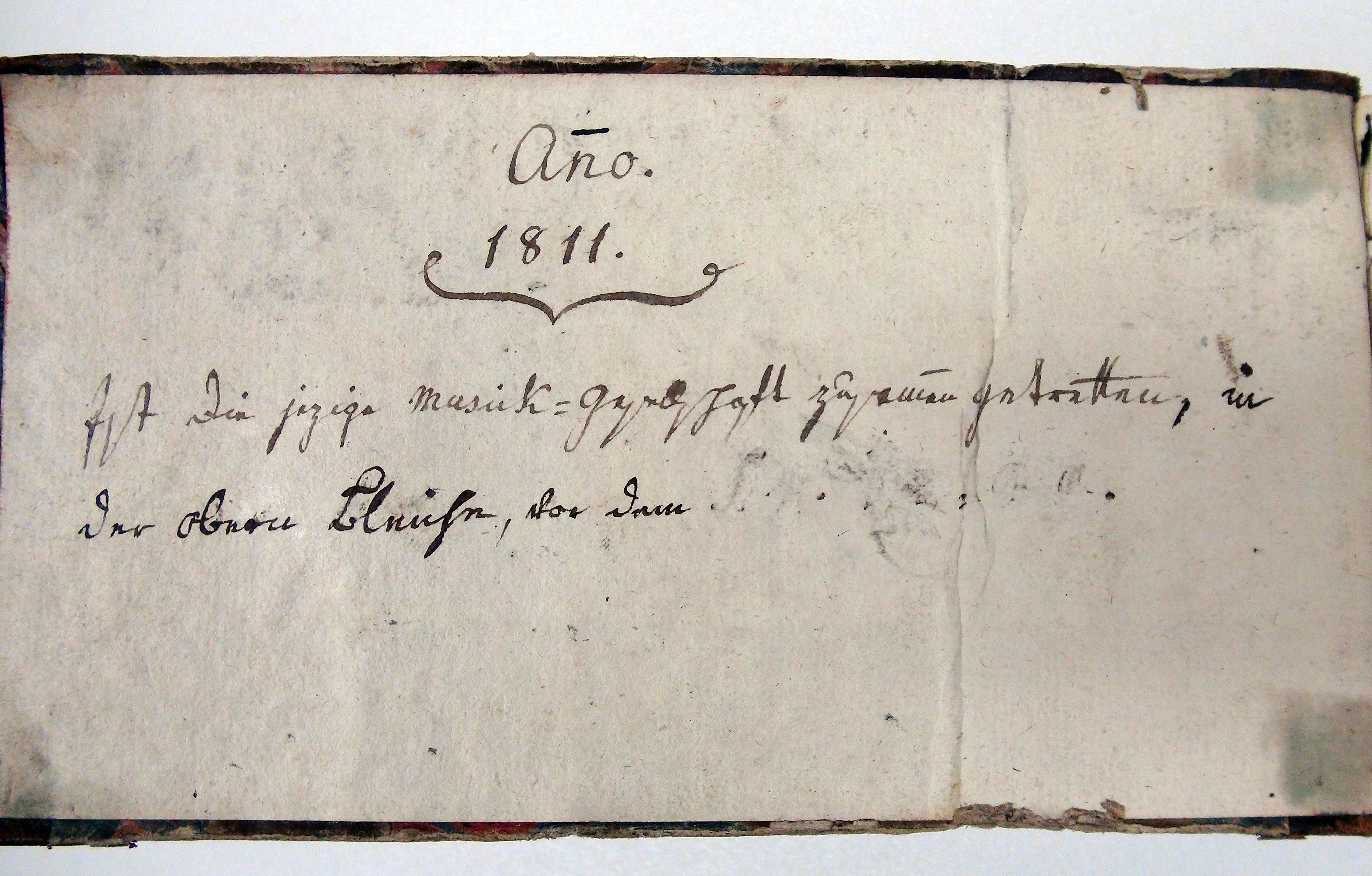
"In the year 1811, the present music society has gathered"
In the Klingendes Museum Bern ("Sounding Museum"), there is a collection from the first half of the 19th century, consisting of 20 wind and percussion instruments and 49 handwritten music notebooks. The four-year project aims to trace the genesis of a then-new form of wind music, which has continuously evolved into its modern form, using this uniquely multifaceted source as a model.
This “Hundwil Collection” originates from two music societies in Eastern Switzerland that cultivated this new form of wind music, featuring clarinets as melody instruments and extensive use of percussion. The interconnections between the preserved instruments, over 450 musical pieces (including various marches, waltzes, and pieces from operas), and the numerous details in the notebooks (e.g., names of players, concert dates, and programs) make the collection a particularly compelling source. Its three distinct historical layers also allow for the reconstruction of the early development of military or civilian wind music, such as the continuous addition of new pieces to the part books or the incorporation of modern brass instruments with valves by the mid-19th century.
The research team examines this from three perspectives: instrument studies, historical research, and musicological analysis. The findings will be shared with both the academic community and the broader public through a symposium, publications, an exhibition, concerts featuring the music on historical instruments, and published editions of the scores.
Figure: The earliest date mentioned in the collection can be found in the music book of the drum: “In the year 1811, the present music society has gathered in the ‘obere Bleiche’, before …” © Klingendes Museum Bern
Ausstellungseröffnung
Im Klingenden Museum Bern liegt ein Konvolut aus der ersten Hälfte des 19. Jahrhunderts, bestehend aus 20 Blas- und Schlaginstrumenten sowie 49 handschriftlichen Notenbüchern. Dieses «Hundwil-Konvolut» geht auf zwei Musikgesellschaften in der Ostschweiz zurück, die die damals neue Form der Blasmusik mit Klarinetten als Melodieinstrumenten und viel Schlaginstrumenten pflegten.
Seit dem Jahr 2023 untersucht die Hochschule der Künste Bern dieses Konvolut im Rahmen eines Forschungsprojekts, das der Schweizerische Nationalfonds SNF finanziert, um daraus das Entstehen einer damals neuen Form der Blasmusik zu erfassen. Dabei konnten die Forscher*innen bereits aufzeigen, dass die ältesten der im Museum erhaltenen Notenbücher und Instrumente sogar auf die Zeit vor 1800 zurückgehen und dass sich Musik und Besetzung dieser Blasmusik danach kontinuierlich modernisierten.
Die Sonderausstellung «Anno 1811» im Klingenden Museum, das Partner im SNF-Projekt ist, vermittelt von April 2026 bis März 2027 nun erste Forschungsresultate: Sie lässt die Wiederaufführung dieser Musik mit Videos erklingen, zeigt die Originalinstrumente und noten und lässt das damalige Vereinsleben aufgrund neu entdeckter Dokumente aufleben.
Medienberichte (Auswahl)
Swissinfo 1

