Veranstaltungen
When?
Prelude #11
Sat, 6 December 2025, 21:00–22:30 CET (Check for your own timezone)
Where?
Online
For more information on the 4th Global Piano Roll Meeting (7–9 August 2026) see here.
For more information on the Global Piano Roll Meetings please the the GPRM website.
For the running Global Piano Roll Meeting Preludes series see here:
Prelude 9: see here
Prelude 10: see here
For more information on the 3rd Global Piano Roll Meeting and its Preludes, please see here.
For more information on the 2nd Global Piano Roll Meeting and its Preludes, please see here.
Hosted by Hochschule der Künste Bern, in collaboration with Stanford University, Sydney Conservatorium of Music and FaszinationPianola


We are pleased to announce that the Global Piano Roll Meeting series will continue.
The next prelude will present papers by Hermann Gottschewski on distinguishing types of Welte-roll punchings across periods and locations and by Artis Wodehouse on George Gershwin's piano rolls. Program with abstracs (pdf)
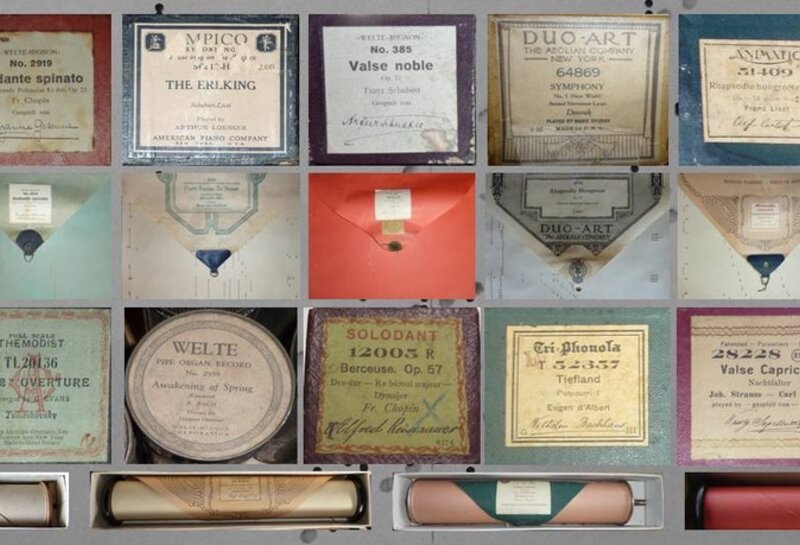
Music rolls and pneumatic instruments are a vital part of the history of recording and mechanical music. They provide a rich window into the technological, musical, cultural and economic history of the late nineteenth and early twentieth centuries. Recent projects to preserve rolls by scanning and digitization have sparked wider interest in the field. This work has allowed for technical studies of rolls, which are an early digital record of music making. Archival documents are also yielding insights into the business and technology of roll manufacturing.
The 4th Global Piano Roll Meeting (GPRM) will take place at Stanford University, August 7–9, 2026. The program committee invites proposals for individual papers, organized sessions, lecture-recitals, panel discussions, posters, and performances.
Call for Papers (extended deadline: 30 November 2025) (pdf)
This bi-annual meeting, which follows the 3rd meeting held in Sydney, Australia 2024, is an international forum that fosters community and supports inquiry among professionals, students, and enthusiasts working with paper rolls and pneumatic roll-playing instruments. GRPM is an initiative supported by Stanford University, University of Sydney, Faszinationpianola and Hochschule der Künste Bern HKB.
KALENDER
- 8./9. Oktober 2026Les mouvements artistiques sécessionnistes (Paris, Berlin, Vienne et au-delà)
Ce colloque se propose de confronter dans une perspective comparée diverses tendances de type...
mehr lesen - 28. Oktober 2026Forschungs-Mittwoch Doktoratsprogramme Musik
Die HKB bietet MA-Absolvent*innen aus der Musik drei wissenschaftliche oder...
mehr lesen - 4. November 2026Assoziierte Forschende: Präsentation der Projekte
Assozziierte Forschende der HKB präsentieren ihre Projekte. Nähere Informationen folgen.
...
mehr lesen - 12./13. November 2026Cooperative Practices in the Arts from 1800 to the Present
The workshop addresses cooperative forms of working together in the arts from the early 19th century...
mehr lesen - 14. November 2026Global Piano Roll Meeting Prelude 13
We are pleased to announce that the Global Piano Roll Meeting series will continue.
Music rolls and...
mehr lesen

Die Hochschule der Künste Bern
ist ein Departement der Berner Fachhochschule
